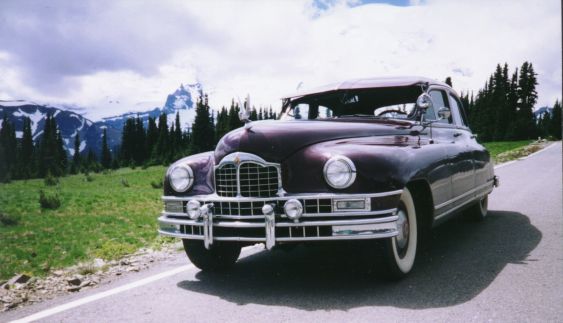


Scott & Gayle-Marie’s 1948 Packard Custom
It isn’t enough to merely have an expensive hobby like
old car restoration. If you’re going to go broke why not
do it with some style? Well, obtaining a luxury
automobile like a top-of-the-line Packard is normally
out of reach of someone still in college and raising a
family. A pre-war senior model was pretty much out of
the question. The ideal (affordable) choice appeared to
be the underappreciated yet no less well engineered ‘48
Custom, and so the search began for this very model.
Before long I managed to locate one in Puyallup,
Washington, which had been sitting in a garage since
1962. The owners had received the car in payment of a
debt from operation of a failed Union76 service station,
but they no longer drove it. They felt it was too large
for the streets of Puyallup, and the clutch (what
clutch?) was oil soaked and ineffective – either
locked or released, no in-between. Getting underway was
an adventure – hills could be your  friend or your enemy,
depending on which way you were pointed. The tires were
like new (well, in 1962 anyway) top-of-the-line Union
76. The finish was a peeling dark red and sported a dual
band white racing stripe from front to rear. We arranged
to meet for a test drive and inspection. This nearly
ended in disaster. During the test drive as we neared a
T-intersection, with us having the straight-through
right of way, a motorist sat at the stop sign observing
our approach. When we reached the intersection, he
suddenly gunned it directly into our path and braked to
a near stop. I scrubbed more rubber off in that instant
than the tires had lost in their entire life and
narrowly avoided a collision. The motorist took off and
while his actions remain unexplained, the brakes had
passed the driving test. On to the next...
friend or your enemy,
depending on which way you were pointed. The tires were
like new (well, in 1962 anyway) top-of-the-line Union
76. The finish was a peeling dark red and sported a dual
band white racing stripe from front to rear. We arranged
to meet for a test drive and inspection. This nearly
ended in disaster. During the test drive as we neared a
T-intersection, with us having the straight-through
right of way, a motorist sat at the stop sign observing
our approach. When we reached the intersection, he
suddenly gunned it directly into our path and braked to
a near stop. I scrubbed more rubber off in that instant
than the tires had lost in their entire life and
narrowly avoided a collision. The motorist took off and
while his actions remain unexplained, the brakes had
passed the driving test. On to the next...
August, 1986. With mainly mechanical and cosmetic issues but a nice original maroon interior, I decided to purchase the car. I arranged to return at a later date to pick the car up and drive it to Richland, with a planned layover in Tacoma (abt. 225 miles). The owner had prepped it with an oil change and general tune-up. One of the non-functional items observed during the test drive was the overdrive. I attempted to diagnose the problem in Tacoma. All the voltages checked out, but the solenoid would not pull in. With the solenoid removed, it would pull, but back in place it would quit working. Puzzled, but thinking there may be an internal mechanical problem in the shift pawl (though it seemed I could move it far enough by hand), I decided I’d just have to drive it back to the Tri-Cities without it. The temperature gauge indicated high temperatures as well and fluctuated with engine load. Being mid-summer, I was concerned about that, and had to be careful not to load the engine excessively in order to keep from pegging the gauge. Aside from a rather noisy rear-end, the drive back was relatively uneventful, though a bit slower than I had planned.
What I discovered later as I tore into the mechanical issues was a reversal of two wires to the solenoid. Both come from the same source on the relay but one runs through the dash lamp as an indicator on its way to a set of solenoid contacts, while the other supplies the current directly to the windings. With the wire reversal, the pull-in current was passing through the light bulb in the dash, limiting current, though the voltmeter gave no clue during my initial diagnosis. Mystery solved.
I suspected the thermostat was the cause of the over temperature problem, but pulling the hose neck revealed the complete absence of a thermostat. I tested the sending unit in hot water with a thermometer and found it to be wildly inaccurate – reading way too high. In reality the engine was running cold all the time with that thermostat out. Replacement of both was in order.
Replacement of the clutch and exhaust system and cleanup of the brake system at least made the car drivable. I then put it away for a few years as I struggled to keep the kids fed.
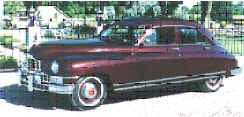
Eventually I decided to begin the restoration in earnest. To keep things manageable, I decided to tackle it a piece at a time; taking each door, each fender, hood, trunk lid, then finally the body one at a time stripped to metal, welded, primed and surfaced. Primer through topcoat (a grenadier maroon with clearcoat) is all catalyzed epoxy material. Rubber, window channeling, glass, etc. were replaced. But this being a shoestring backyard project it took three years to complete, done all by hand, including the mechanical and other internal work. My wife, Gayle, handled most of the minor upholstery repair. The only thing not tackled myself was the rechroming, due to lack of equipment. The driving force towards completion was the annual Packard Automobile Club (PAC) national meet, held in Reno, NV the final year of the restoration effort (in July 1994). The trip was to be our honeymoon we never had. Rarely is a national meet so close to home, as PAC had no regional presence in the northwest. To complete the car in time I sprayed the topcoat in December, reassembling it and piecing out the rechroming over the winter.
July 1994. We were scheduled to depart on a Monday, and I had finished reassembly the prior Friday. It was time for an anxious test drive after the eight year hibernation in my garage. It was then I (re)discovered the noisy rear-end. Oh, yea...
Saturday night – shop light and bugs buzzing – was spent in the driveway pulling the axles and differential. Bearings were couriered in so Sunday could be spent carefully rebuilding the differential. With the family tucked snugly into bed, Sunday night through Monday morning passed reassembling everything. One hasn’t really lived until he’s single-handedly bench-pressed a senior Packard differential into precise alignment and wrestled it firmly into place (though many have died, I’m sure). That morning, grease under the fingernails, the trip to Reno became the test drive.
The venture required a circuitous route to accommodate everyone – Tacoma (to drop the kids off), Sacramento, Reno – over three thousand miles in all. The only problem experienced, beginning in southern Oregon, was a plugging fuel filter due to rust in the fuel tank. Every few hundred miles required a cleaning, and a few times the fuel line would have to be back-blown with a piece of hose and lung power when a large piece got caught by the pickup tube. I suspect our "modern" gasoline had a lot to do with loosening up crud in the fuel tank – explaining why it was okay during the first part of the trip. Otherwise, the car used only a quart of oil (the engine has not been rebuilt) and performed without mishap.
 Since the trip,
I’ve pickled the tank with phosphoric acid, rebuilt the
transmission, and installed wide-whitewall tires
(finally retiring the vintage rubber). We hope to enjoy
the car for a long time to come, having all the hard
work behind us. Realizing Packard’s renown reliability,
it should provide many years of trouble-free service.
Since the trip,
I’ve pickled the tank with phosphoric acid, rebuilt the
transmission, and installed wide-whitewall tires
(finally retiring the vintage rubber). We hope to enjoy
the car for a long time to come, having all the hard
work behind us. Realizing Packard’s renown reliability,
it should provide many years of trouble-free service.
Scott & Gayle-Marie Noga